Success in a pandemic

There’s nothing like a world pandemic to shake up our assumptions and priorities! I’m pretty sure many of us used to feel quite confident about our career paths and definitions of success. But now all that doesn’t feel so straightforward anymore, when not just our careers, but some of our industries are largely on hold.

When we first entered lockdown the definition of success suddenly became finding toilet rolls and pasta at our local supermarket. Many of us had a crash course in sorting out new financial plans and strategies with little or no income, negotiating rent freezes or mortgage holidays, government help schemes and benefits.

After months of staying apart from our friends, family and colleagues, success developed into a socially distanced walk with a friend, connecting with neighbours you previously didn’t know well, or an online get together with people you care about.

As we slowly move back into circulation, many of our measures of success are still fairly modest, such as getting back on public transport or having a meal out. There is still a lot of anxiety about getting back out there and life is still far from normal, but I know I am slowly starting to re-engage with the outside world.

It would be wrong to suggest it has all been bad though. I reckon I have achieved a PhD in Zoom. And, an unexpected benefit of moving all the FEU Training workshops online is that they have become more accessible to people who couldn’t previously attend. Not just geographically but also for people with disabilities who can now attend because they can manage their energy better as they attend from home. Even when we can hold face-to-face training again, it is our intention to continue with online workshops to maintain this benefit.

Months of living life in a different way and at a different pace has given many an opportunity to really think. Some have been surprised by the conclusions they have reached. Many recognising that they have been on a tread mill, disengaged from the bigger picture, are now making plans for the future that takes them in a new direction, with a different focus and priorities.

I’m speaking to lots of people who are finding pleasure in exploring their talents, interests and passions in new ways without feeling the pressure of making it a permanent career strategy. For some, they are actually rediscovering what it is they love about their work.

At risk of being controversial, could this also be a time of opportunity? I speak to many of our members who have turned their creative juices onto working differently in this new environment and there have been some great ideas. I’ve seen zoom plays, online musical gigs and some community projects.

People are connecting with each other in new ways, and a by-product of whole industries being at home is that previously inaccessible people are now more available and potentially open to new approaches. There are opportunities for new alliances and partnerships.

So how are you viewing success for yourself at the moment? These past few months have been different for all of us. If you have not yet had a chance to ponder this, maybe take a moment and ask yourself the following questions:

  • What are the aspects of your life before Covid 19 that you want to retain and re-engage with?
  • What were you doing before that you don’t want to return to?
  • Has the experience of that last months changed your priorities? If so, how?
  • Is there anything you have been doing during the last months that you could develop into a career opportunity?
  • What does success look like to you now?

Further info: view our 'Strategies for success' webinar recording.

Keep your options open

For many of us at the moment, things are undoubtedly tough. And, as human beings, we have developed many ways to make it even tougher than it needs to be. For example, sometimes we catastrophise, taking a bad situation and imagining everything getting worse and worse with each decision we make. Or we can generalise strife in one area of our life into every area, by feeling upset about a work issue and then compounding it by picking fights with loved ones.

The best way to deal with both of these is to notice what you are doing and step back to see if you can find other ways to deal with or express your feelings.

What I want to consider in this blog though, is the way many of us narrow our choices in a complex situation down to just two option – I’ll call them X or Y. I remember working with a client who had a huge argument with their partner. They only saw two options: either to leave their partner of ten years or put up with their behaviour. Imagine being that person who has narrowed their choices to such dramatic extremes. I can disrupt my entire life or, I can put up and shut up. That is a difficult decision to make but also perhaps an unnecessary one.

And who amongst us has not put themselves in this sort of position where we only see two choices? I know I certainly have. I remember when I graduated, the country was in the middle of a recession and I couldn’t get work as a graduate. I finally got a Christmas job in a jeweller that went on to become permanent position. I was desperate to move on but convinced myself that it was that job or no job at all. It wasn’t until I got a last-minute opportunity to do Camp America that I suddenly realised that there were many other options open to me. As it turned out, ditching the job and going to America for four months was one of the best things I ever did.

So, if you ever find yourself narrowing your choices down to X or Y, you should train yourself to set off a warning flag in your brain. Having two options is not a choice, it is a dilemma! It is actually the structure of a problem. It shuts down all possibility for creatively searching for new possibilities. You just mentally stand there going, “On the one hand… on the other hand.”

So, if you notice you are doing this, stop, sit back and find some other options, three is the bare minimum, but aim for five. When we are thinking like this, it can be hard to come up with options, because usually we have convinced ourselves there are none. So it may be helpful to ask a friend or family member to brainstorm options with you. It doesn’t matter how seemingly bizarre some of those options might be because an outrageous suggestion can sometimes spark other more practical ideas or, when considered seriously, be a fantastic innovation that changes your life.

Going back to the client I mentioned earlier, I pointed out how her two options, leave or stay with no room to manoeuvre, were at two extreme ends of a continuum. We worked together to create other options, such as talking to the partner directly or with the help of a couple counsellor to consider how their behaviour might have contributed to the situation and what they could do about that, as well as talking about other events that were going on in other parts of both their lives.

As with most things in life, the main issue was one of poor communication. At the end of the conversation, neither of the two original options were even on the table as first steps. There was no guarantee that they would sort out the relationship, but my client had a range of options to try before they called it a day. This meant, instead of being stuck with a dilemma, they could take action to change things for themselves.

So, even though things at the moment might be tough, learning to pull back from narrowing your options down to X or Y and challenging yourself to come up with others is a useful way to ensure that you keep moving forward.

Working from home with the family in tow


Many of us are used to working from home. We’ve probably got some sort of routine sorted out and various tricks we use to motivate ourselves. And, on those rare occasions when we are not feeling motivated, there isn’t usually anyone around to notice if we watch a couple of episodes of our favourite Netflix show in the middle of the day.

Well hasn’t that all changed. For some of us our work will have disappeared completely, others will be juggling trying to do things remotely for the first time ever. And for those of us who don’t live alone, where did all those people come from and when did the house get so small?

At this point, I think it’s important to recognise that what is happening is HUGE. It’s affecting everyone… everywhere. So, what can we do to make this a bit easier for ourselves in the meantime?

Adjust your priorities

Whatever was important to you at the beginning of this year is unlikely to be at the top of your list right now. Take some time to think about what is really important to you right at this moment? You might be surprised with some of the answers you get.

I know I really wanted my son to come home from university so we could celebrate his 21st birthday in March. Now I want him to stay safe where he is and for us to not add to the potential spread of this virus. Who could have predicted that a couple of months ago?

An achievement today could include being stocked up with toilet roll and hand wash. It could be successfully managing your stress levels. Don’t judge yourself and your performance on pre lockdown standards because they no longer apply.

Getting on with household members

For many of us who normally work at home, the house once emptied as partners/housemates go to work and offspring head off to nursery, school or college. Then we had peace and quiet to organise our time and environment and, do our thing. Now many of us are competing for the same spaces and the same computers or bandwidth with other family members.

Rather than get into arguments about who’s work, or homework is more important, it may be worth having a family discussion that includes who needs peace and quiet or certain spaces when. Of course, this is much more difficult when accommodating younger children, but then childcare duties may have to be part of this negotiation.

I know in my case I was suddenly spending a lot of time on Zoom, and the only room suitable was our front room where the family normally relaxes and watches TV. My work became so disruptive that we moved the sofa and TV out of that room and squeezed them into our open plan kitchen dining room, making the front room my temporary office. Not ideal, but at least I’m no longer disrupting the whole household every time I need to go online – and they aren’t disrupting me!

Children

I’m lucky in that my children are older, so they are capable of fully understanding the situation and working with us. My neighbour’s toddler is constantly asking when she is going back to nursery and has no comprehension why she can’t go and see her friends. That must be tough.

Many parents I know are stressing themselves out trying to pick up where the teachers left off. Some good news, I have heard several teachers advising parents to relax, the schools will help pupils catch up and get back on track very quickly when they reopen. So keep it simple - get them to read books if you can and expand your interpretation of education to include helping around the house more, cooking and baking, art, board games and, of course, some guilt free screen time. Your sanity is important here too. Children will bounce back from this more quickly if there is less stress about what they are doing every minute of the day.

Teenagers

I know there are additional worries with older teenagers and students too. My eldest is in third year at university and my youngest was about to sit his A Levels. Both are going to be graded on what they have done so far and how their teachers feel they could have done. Some educators are continuing to provide work others are not. Again, this is a time to go with the flow. Worrying about what their grades are going to be won’t actually improve them. And remember that everyone in this cohort is in the same boat.

Keeping safe

Some of us may be in the unfortunate position of having to spend time with family members we do not get on with. It is important to recognise that the number of domestic violence incidents have increased substantially since we went into lock down. If you or anyone you know may be in this position, let them know that if they ever feel they need help they can call 999, wait till the call is answered and dial 55, then without having to speak, help will be sent.

Useful links:

BBC Bitesize https://www.bbc.co.uk/bitesize

A prioritising too from Mindtools https://www.mindtools.com/pages/article/newHTE_95.htm

Announcement – Venue based Workshop Suspension


Due to the continuing effects of the Coronavirus, we will be suspending our face-to-face training and events programme in the short-term.


Let’s get together online

We’re aiming to expand our online programme in the coming months including additional webinars and interactive learning and communication opportunities. Please look out for updates.

We’ll be resuming our venue-based programme as soon as appropriate and will let you know when this happens.

Available now

In the meantime, there is a range of online learning opportunities available to you including e-courses, webinars and tutorials.

We look forward to seeing you again in the near future.

Warm wishes from the FEU Training team.

5 steps to being more confident

There is a real aura that surrounds someone who is truly confident. It’s an authenticity, a comfortable relaxed presence that in itself inspires confidence in others. A confident person is someone who knows what they want and how they think, but who doesn’t believe that their perspectives override what others think or want. Examples that spring to my mind are people like Barak Obama, Martin Luther King, Oprah Winfrey, Beyoncé and Bear Grylls. I’m sure you can think of many more.

It’s easy to mistake brash loudness and attention getting strategies for confidence. So much so that sometimes people on our Confidence workshop say they are not sure that they want to be confident if it means coming across as arrogant!

However, for me confidence is never arrogant, it is about being comfortable in your own skin - not necessarily having all the answers but open to learning. It’s a deep knowing that each of us has the right to take up our space in the world and when we are challenged or attacked, being able to deal with that without doubting our own right to exist, or our right to believe in what we do.

Confidence is about being prepared to change your mind if you are presented with new evidence or perspectives that, on reflection, you agree with.

So how do we all get closer to this? Here are some ideas:

  1. “Be yourself, everyone else is taken.” Oscar Wilde

Many performers start their careers by copying others, “I’m going to be the next Adele!” The problem is that this position is already taken and, let’s face it, no one is going to do Adele quite like she does. Of course, we all emulate our heroes as we learn our craft, but it’s what we personally bring that makes our work stand out as special.

While we are trying to be someone else, we often edit out important elements of ourselves, for example, we may hide our sense of humour, or our resourcefulness or our compassion. So how do we come to appreciate that the special quality we have to offer in any situation is our uniqueness?

One way is to become more aware of our inner critic and work on making friends with it. Speak to yourself in a more kindly and supportive way.

Another way is to become aware of how you ‘do’ confidence. All of us have areas in our life where we are already very confident. Identify one of those areas and work out how you do it. What do you focus on, what do you tell yourself about it and how do you address any obstacles that crop up? Then see how you can use those same strategies and approaches in those areas where you would like to be more confident.

When we are comfortable being our unique selves, we don’t try to hide aspects that we are worried might not be good enough. The classic imposter syndrome thinking is, “If they really knew me, they would see what a fraud I am.” Imposter syndrome is very common, you can read more about it here.

Being yourself means that you are actually present in the room, in the job, in the relationship. It means you are not distracted by a lot of self-doubt and self-chatter that takes you off into your own inner world. Instead you are there, seeing and hearing, and able to react in real time to what is happening around you. And, with such focus you feel and appear to be more confident.

  1. Find your courage

Fear keeps many of us from even trying to take steps in a new direction or from approaching a new opportunity. What are we actually afraid of? Making mistakes, being ridiculed, people being angry or hostile? Wild tigers jumping out of the bushes and eating us? How realistic are these worries? I remember someone saying to me when I was worrying about approaching new clients, “No-one is going to shoot you!” I laughed, but it made me realise that I was behaving as though that were actually a possibility.

So how can we alleviate some of those fears? Well, it’s often a matter of taking a leap of faith and getting on with it. If you make a mistake, say sorry and do your best to put it right. If people ridicule you, laugh with them or if it is cruelly intended, find another job. If people are angry or hostile, find out why and learn from it. Wild tigers? Well… avoid safaris.

On the whole, we treat all our fears as though they are all man-eating tigers. Our physiological responses of anxiety are identical to our primitive reaction to life or death situations. Learning to calm our fears can change our whole outlook.

Many of our fears originate from childhood when the adults around us had all the power and probably for good reasons wanted us to stay quiet, or compliant, or safe. We are no longer in that position and the more you take a chance or a risk, the more you will become comfortable in the knowledge that the outcomes from most situations are perfectly manageable. Of course, I am talking about taking risks in areas such as asking for more money or for a work opportunity. I am not suggesting you start entering tiger enclosures at your local zoo!

  1. Please yourself

My mum used to say, “You can’t please everyone, so you might as well please yourself.” While I can think of many situations where she didn’t expect me to apply that (see the point above), the sentiment has stayed with me. I have learned the hard way that when you try to please everyone around you, you usually fail, and you end up doing things you didn’t want to do.

I’m not suggesting that we should all start marching round shouting, “It’s my way or the highway!” While there may be some situations where we do feel like this, there will be many others when we are given the opportunity to choose what we would prefer to do, where we can express our preference honestly rather than try to guess what the other person would like us to choose.

I’ve learned that everybody has a better time when we all take responsibility for ourselves and say what we want. And this is true in our creative careers too. If you spend all your time trying to please different groups, you may end up going down a creative rabbit hole where you have committed too much of your time doing work you don’t care for.

Being confident involves staying in touch with what youcare about and learning when you have the opportunity to choose a path, to choose the one that will most please you.

  1. Don’t confuse confidence and competence

I often speak to people who feel they can’t be confident unless they are highly skilled in a specific area. To me, confidence and competence are completely separate. Of course, it is likely that if you are highly competent in a subject or skill you will also be confident in this.

But this doesn’t mean that your overall confidence is dependent on being an expert in any field. You can be confidently incompetent! By which I mean you can retain your inner confidence, which we have defined above as being present, open to learning and comfortable in your own skin, without knowing anything about a specific topic. Being confident allows you to admit to yourself that you’re not competent at everything but are open to learning if you choose to do so.

  1. Keep an achievement file

Most of us to a greater or lesser degree operate a negative bias towards feedback, where we can remember in the most exquisite detail something that went wrong five years ago, while instantly forgetting all the praise and great reviews or comments we received last month.

Because it’s so easy to forget about all the great things you have done, it’s important to find some way to capture them all in one place. I find an achievement file is a great way to do this. Every time you get a complimentary email, letter, or review put a copy of it in this file.

Then, if you find yourself feeling a bit lacking in confidence and need a boost, you can pull this file out and remind yourself of how far you have come, what you have learned and achieved, and how many people appreciate what you do.

More info

I hope you like these suggestions for building your confidence. For more tips and advice, do watch our Webinar recording on Building Confidence or do our e-course on Overcoming Freelance Challenges.


2019 – Ready to Launch!

Did anyone else watch the clock cross its annual threshold and feel a bit underwhelmed? I am surprised that I have come to feel this way, because I am Scottish, and New Year when I was growing up was a very, very big deal.
In Scotland, New Year was a much bigger deal than Christmas. In fact, Christmas day only became a public holiday in Scotland in 1958. There’s a very interesting article on this from The Scotsman.

I remember moving to London 30 years ago and being dumbfounded at how lavish the celebrations for Christmas were and how minimal they were for the New Year. I think nowadays this has largely evened out in both locations.

From my adolescence I remember the whole household being involved in the top to bottom cleaning of the house, which included polishing silver, washing out cupboards and cleaning mirrors. Even the cleaning cloths had to be washed and hung out to dry before the clock struck midnight. This was a bit of a downer for my poor my sister, who’s birthday falls on New Year’s Eve.

My mother would slump into the New Year, utterly exhausted. Only she didn’t get to rest. The ‘first footing’ then began, a tradition where friends and family visit each other after midnight, bringing coal or shortbread and a bottle of spirit to share, with with the aim of bringing good luck. This often goes on until dawn. Then my poor mum had the special meal of the day to prepare and serve. This is why the Scottish need an extra public holiday on 2nd of January!

I have not maintained these traditions, but have always previously had a deep seated, fresh start, attitude to the threshold of a new year. So, I started to wonder how I could make this a more useful marker on my calendar. Rather than come up with over ambitious ‘New Year’s resolutions’, maybe I could find a more grounded way to set myself up for 2019. I came up with the following ideas. Maybe you would like to try them too:

Review the year

I use my diary to track what I have been doing, so it’s a good place for me to see in one place what I have been up to over the previous year. I’m always amazed that I’ve forgotten many of the things that I’ve done. I go through it and consider what worked and what didn’t.

I usually make a few notes to remind myself of what I have learned and how I’ve developed new skills. I also jot down what I don’t want to do again, or how I would deal with things differently if I found myself in a similar situation.

I don’t limit this to work, it’s good to see how some friendships have expanded and others have contracted. Reviewing it like this can let you decide if you want to change anything going forward.

You can use this as a starting point for setting or updating goals and we have great resources on our website including a Goal Setting for 2019 webinarrecording and an ‘Overcoming Freelance Challenges’e-course if you want to do that next.

What can I throw out or let go of?

Just as the New Year is a time of beginnings, I also see it as a time of endings and like to set aside a day to see what I can throw out or let go of. I have a habit of accumulating things I am going to read when I have the time. I find it very liberating to admit that if I have not found the time to read them, I am not going to, so I bin or delete these items.

I sort out clothes or ‘treasured possessions’ that are either taking up valuable space or gathering dust. I once read an article that said you should thank the item for the pleasure it has given you, then let it go. I find it definitely makes it easier for me. What I love is the empty space this creates in my home.

I also take this opportunity to purge things that hover on the outskirts of my to do list such as people I always mean to spend time with but don’t get round to, new jobs I am going to pursue and chores I am going to get around to. My reasoning is that if any of these were truly important to me, I would have done them. Taking them officially off my list of ‘must do’s’ is incredibly liberating.

How can I be kinder to myself?

I have a habit of putting what everyone else wants before myself. I have spent some time this year thinking about how I can be kinder to myself. Things like saying no to friends and family when saying yes to them means saying no to something important for me.

I’ve decided to put some ‘me’ time in the diary, i.e., time where I don’t necessarily have an activity scheduled, where I can sit and think, read a book or go for a walk. Having it in my diary means I am far more likely to stick to it.

What new thing can I try?

I recognise that I am getting more stuck in my ways as I get older. I used to be pretty adventurous and now find I am far more stuck in my routine and comfort zone. So, I have made a list of new things I would like to try or things I would like to do more of, which includes:

  • Joining a dance class
  • Learning something new that is completely unrelated to my work
  • Taking country walks on my own
  • Doing something artistic

However you decide to start 2019, I wish you all the best. If you decide to try some of these ideas, do let me know how you get on.

Happy New Year!

5 Strategies for Success

On reading accounts of how people became successful, it is clear that there are many different routes. Amongst all the variations though there are some consistent themes, which I will share here.

Before we get into strategies, it is important to consider what we mean by success. We often speak as if we all have a shared understanding of what ‘success’ is, but are we all describing the same thing?

Some people who we may perceive as successful such as movie stars, millionaires or even US Presidents, may seem on the surface to have hit the jackpot, but give off signs of not being particularly fulfilled or happy with their success. On the other hand, I have met many people who would not be considered conventionally successful but who have achieved a balance in their life between their career and personal life and who consider themselves to be very fulfilled and successful. Have you ever taken time to work out what you mean by success?

When we don’t pause to consider what success means to us, we risk heading down a path without considering fully where it will lead. Stephen Covey, in his book, The Seven Habits of Highly Effective People, described his experience of this as, “Climbing the ladder of success to find it is leaning against the wrong wall.”

To help you be clearer about what success is for you, consider the following questions:

  • Will you be successful when you achieve a level of skill, recognition or financial reward? If so, what level of skill, how much recognition and how much money will be enough?
  • How will you know when you have it? What evidence will you use?
  • How will your friends and family fit in to your ideal view of success?
  • What other areas of your life are important to you that need to be taken into consideration too?
  • Is your definition of success actually yours, or is it something you are working towards because family, friends or a teacher told you it would be good for you?

Take time to really think about these questions and when you have answered them you will hopefully have a clearer idea of what you want, so you can work towards it with more enthusiasm, secure in the knowledge that your ladder is leaning against the right wall for you.

So, what are the strategies that can help you get there?

  1. Do something you care about

Being successful often involves a big commitment of time, energy and focus. It is much easier to commit and prioritise these resources when you really care about what you are doing. It may be possible to progress well doing something you don’t really like, but, if your definition of success includes enjoyment, liking what you are doing is essential.

While for some people this will involve working towards the same goal in the same industry for their entire career, this is not compulsory. It doesn’t have to be your life-long dream, it can be something you are passionate about right now. I read many accounts of successful people, which included instances where they followed a specific interest while it lasted, then used all they had learned from that, to pursue the next area that attracted them.

  1. Think long term

Successful people don’t assume it’s all going to work out next week. Instead they think in decades. Which is why point one is so important: if you are going to be doing this for years, you’ll not want to be counting the days till it’s over.

The big advantage to thinking long term means that all your successes and failures are viewed as learning opportunities on a larger project. This takes off the pressure, as it lets you remove the expectation of instant success, which means you can take the time necessary to hone your craft, develop your skills and to make mistakes and learn from them.

Remember that nearly all of the so called ‘overnight successes’ have been working hard for years, learning their craft, networking with the right people and just turning up again and again until the right door opened for them at the right time. Not just a chance event, a result of being in that right place on numerous occasions when it wasn’t the right time and then going back again and again until it was.

  1. Take action

Another important theme is to take action. Do something, especially when you feel stuck and can’t see the point. On a number of occasions when I have felt things are not going well for me, I have sent out half a dozen email enquiries or applications. Most fell on stony ground but usually one or two led to some work. The greatest benefit of taking this action was that it got me back in a better frame of mind.

Autobiographies by people you admire can be a great source of inspiration when you realise that very few people have a smooth rise to the top. Most people have major setbacks and often stumble on the way up. It can be encouraging to read about how they overcame obstacles and what it was that made a difference for them.

I guarantee that you will never read an account that says, “I experienced a setback, crawled under my duvet where the Royal Philharmonic Orchestra leader/Editor of The Times/Casting Director for James Bond found me six months later to offer me my dream job.” Going into hiding physically or mentally is nevera useful strategy.

So, don’t get hung up about only doing the ‘right’ thing, just stay engaged, keep yourself out there and take some action. Then review what worked for you and do it again or if it didn’t work, do something else!

  1. Keep getting back up

Life is full of setbacks and so are most people’s careers. The trick is to see what you can learn from them and get back up. Columnist Arianna Huffington once said that people see success and failure as opposites, but failure is an integral part of success.

People who have experienced few setbacks or who have been protected from them have been deprived of opportunities to learn how to find solutions for themselves. More importantly they have likely not been able to develop robust personal resilience. Learning to deal with setbacks is an essential personal development tool. I’m only partly joking when I say that really, we should be grateful for the opportunity when things go wrong.

So, when plans go awry, as they inevitably will, instead of asking, “Why me?” or “Why am I so unlucky?” Ask yourself, “What else can I try here?” or “What can I learn from this, so I don’t find myself back here again in future.”

The important point is to get straight back up and focus on what you can doabout it.

  1. Taking care of yourself

Finally, and very importantly there was a clear theme about taking care of yourself. Not just in the usual ways by eating a good diet, getting enough sleep and exercising, but by taking care of who you are.

It can be easy to be diverted down paths that are important to other people, and as long as these paths are aligned with where you eventually want to go, this can be fine. When you find yourself doing work that doesn’t match your values and you feel uncomfortable with it, then looking after yourself in this context would involve finding a way to extract yourself, to find work that is more appropriate for who you are and what you want to be doing.

I realise that as creative freelances we can’t always get our ideal work, but we all have our boundaries and limits and when these are clashing for us, self-care involves paying attention to this and doing something about it.

So those are our five strategies for success, we hope you find them useful.

We have a recording of our Strategies for Success Webinaron our website as well as many other resources on our Digital Learning Centre.

Why do today what you can put off until tomorrow?

I’ve been meaning to write this blog for a couple of weeks now and have only just realised how much I have been putting it off. Why? I enjoy writing blogs, and procrastination is something I know a lot about, and not just from first-hand experience.

There are different reasons for not doing things immediately. Sometimes, when I put off a writing task, it’s because I’m mulling it over, refining my ideas, then, when I sit down to work, I get it done in a fraction of the time I would have if I’d forced myself to do it earlier. It’s a constructive rather than destructive delay.

However, there are times when I’ve let things remain undone indefinitely. I can even think of examples of exciting plans for future work that haven’t happened because I put them off for too long and got fed up transferring what I’d meant to do to a new to do list.

I know I’m not alone. Why do we do this to ourselves? I once read in a great book called The Now Habit by Neil Fiore, that suggests that procrastination is not the problem but the solution. Fiore explains that we don’t spontaneously start to procrastinate for no reason. We usually procrastinate because there is an underlying fear –  of success, failure, exposure, ridicule or getting it wrong - the list is endless. The procrastination is a protective mechanism that is trying to save us from that underlying fear. Focusing on the procrastination itself is like trying to heal the plaster cast while ignoring the broken leg beneath it!

I think it helps to recognise that procrastination is a behaviour often driven by fear, because then you can stop thinking of it as laziness or incompetence and address the real issue. We all feel fear at times and the adrenalin rush we get from it helps many people give their best, so it’s not an inherently bad thing. When it gets in the way though, we need strategies to overcome it.

Perfectionism is a form of procrastination. We all want to produce and deliver great work, as close to flawless as we can manage, but when that ambition moves into an endless cycle of improvement or revision, it becomes a form of paralysis. This is often accompanied by self-flagellation as we convince ourselves that it and possibly we, will never be good enough. If this sounds familiar, then you have shifted from conscientious hard work to procrastination.

The first step is to recognise this is happening, then work out what you are going to do about it. It may be time to drag your work out into the daylight and ask someone you trust to give you an honest opinion. Good or bad, this will help you shift from where you are.

Sometimes you might find yourself going around in circles amending one aspect of your work while remaining unaware of other flaws. A second opinion can help you assess whether the work is good enough or does need to be revised further. Feedback whether it is positive or negative is always useful. It’s difficult to create good work in a vacuum, so use constructive criticism to improve your work for next time.

Sometimes we worry about how difficult the task is or how unpleasant or boring it is going to be. A useful way to deal with this is to set a timer for 20 minutes and focus on this task and only this task for that time. Then you will have made a start, which you can build on later in another 20 minutes. What often happens when I do this is, once I’ve made a start, and the timer goes off, I’ve forgotten my concerns and I’m focused on and happy to finish the task at hand. Of course, sometimes I sigh with relief and put it down to come back to later but, at least I’ve made a start and usually have an idea of what I want to do next.

This strategy is also useful if you have a blank piece of paper and are struggling to know where to start or have got hooked into thinking that you have to get your ideas right first time. For many of us, it’s much easier to edit something than to start from scratch. Getting something down without judgement or attempting to make it right first time, gets you to the next step when you can build and develop your initial idea.

If you need an imposed deadline, create it yourself and ask someone who will hold you accountable to make sure you complete the task when you said you would.

Ask yourself if this is still something you really need or want to do. Some tasks stay on our to do list when they are no longer relevant, so rather than feeling haunted by something you meant to do two years ago, but which you no longer feel the same way about, ditch it and move on.

The big thing about all this is to be a bit kinder to yourself when you catch yourself procrastinating, have a think about what the underlying fear might be and find ways to address that. One great book packed with useful tips and strategies is Feel the fear and do it anyway by Susan Jeffers. Then hopefully we can all start saying with conviction, “Why put off until tomorrow what I can do today!”

For further resources do see our e-course and webinar recording on Creative Productivity on the FEU Training website.

Taking on the learning curve

The one certain thing in a creative freelance life is that we have to be able and willing to deal with uncertainty. Whether it’s where our next job is coming from or what new skills we need to acquire when we get there, we have to be adaptable and quick to learn. And most of us are already, but sometimes it can feel difficult.

The good news is that our brains are geared up for life-long learning. Scientists are finding increasingly sophisticated ways to look at the brain to see how it changes in response to our experiences, which is what learning is.

A recent series on BBC4 called ‘The Brain with David Eagleman’ had some fantastic examples of this research. Unfortunately this series is no longer available on iPlayer, but there are clips available and if it is on again, I highly recommend you watch it.

In the series they took MRI scans of taxi driver’s brains while they were studying ‘The Knowledge’, in which they have to learn a vast number of routes and street names in and around London. They discovered that the area of the brain that deals with this type of memory significantly increased in size over the time they were studying. The brain’s capacity for storing this kind of information literally grew!

Another example of this flexibility is shared in a TED talk with neuroscientist Dr Sara Lazar called How meditation can reshape our brains. When Lazar took up yoga in response to a training injury occurring while preparing for the Boston Marathon, she started to notice changes in her mood and attitudes and, being a brain scientist, she decided to study this. Like the taxi driver experience, she was able to measure changes in the brain directly resulting from people regularly practising meditation, e.g., the stress areas got less active and smaller, and the social and empathic areas got more active and larger.

Of course not all examples are positive. I’m reading a book on addiction at the moment, and the same phenomenon is at work here too. As the addiction takes hold, the parts of the brain dealing with pleasure seeking and focus expand and coordinate, driving the addictive behaviour. More good news though is that the brain is constantly open to change, so new behaviours can be learned and unlearned even with addiction.

As far as the brain is concerned the secret to learning is repetition. When we do something for the first time, we lay down a number of new connections in the brain. As we repeat this activity, additional layers are laid on top of the original pathway, allowing the pathway to get bigger and bigger until it becomes a ‘main road’ in our thought processes. So, a new habit goes from being awkward to becoming more comfortable until over time it becomes automatic.

So that’s a brief summary of the technical end. It turns out that learning is not only possible but unavoidable throughout our entire lives. So why does it still feel tough sometimes?

As mentioned above, learning something new takes repetition. This is the same with changing old patterns and habits. So it can be useful, while the brain is getting on with its stuff, to have another way of considering how you are feeling throughout the learning process. That way, if you hit a tough bit, it can help you understand that you are in a necessary part of the process of learning and that, with perseverance, you can push past it and back into the fun bit again.

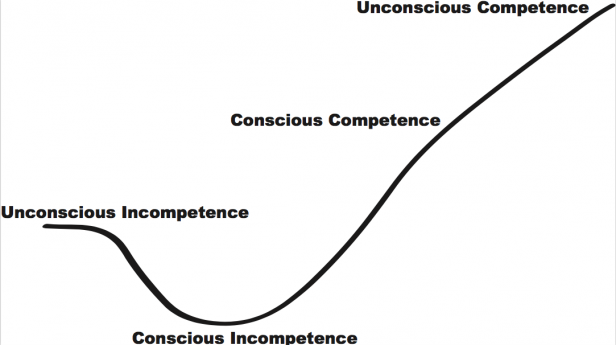
The ‘Conscious Competence’ model (see diagram below) is a helpful tool to use when learning a new skill.


Lets consider how this model applies to learning to play a musical instrument such as the violin:

Unconscious incompetence

Before we ever pick up the instrument, we are unaware that we are missing any skills or abilities. We can’t play, but we’ve never tried, so it’s not a problem. We don’t know what we don’t know.

Conscious incompetence

Once we have decided to learn, we pick up the violin and bow, try to get a note out of it and realise that it’s not as easy as it looks. There are lots of things to coordinate, the angle of the violin on your shoulder, how to hold your arm, where to put your fingers, how to get a tuneful note.

This is when you realise that there is a gap between what you want to do and what you are able to do. This is the stage when many people give up. This feeling can be so uncomfortable that it might feel easier to throw the towel in. However, this is an essential stage of learning: if you don’t ever work out what it is you specifically need to learn and press on through, you will be stuck at the unconscious incompetence stage and not move forward.

Conscious competence

You persevere and start to gain some proficiency on your instrument. You learn what works, where to place your fingers, how to hold the instrument and bow and you begin to be able to make music (of sorts) even if you have to concentrate quite hard to remember to do it all. This is conscious competence, you know what you know, and can take pleasure in your growing abilities.

Unconscious competence

It takes years to learn to play the violin proficiently, but as your skills develop there will be moments when you pick up your instrument and just play without thinking about where your fingers are, or how you are holding it. You will just create music. This is unconscious competence. If someone asked you how you did it, you would struggle to explain it, as you are no longer thinking about the step-by-step mechanics of the experience. Many of the skills have become automatic.

On-going Cycle

The unconscious competence stage is not an end point. Say you have been trained classically, and get the opportunity to play Jazz. Here you have a whole new set of rules, some new moves and ways of using your instrument that feel uncomfortable to you as it goes against all your existing training.

Suddenly you are once again in the conscious incompetence stage of learning. Then, as you work out how to do it on your own/with help and or instruction, you move into conscious competence then finally into unconscious competence again.

The same happens when you go from an amateur orchestra to professional one, the standards are higher and you become conscious of gaps in your skills. Instead of getting disillusioned, recognise that you have dipped back to the conscious incompetence stage, and that this is an opportunity to improve once more.

When we attempt to learn any new skill, the above cycle repeats itself to a greater or lesser extent including what can sometimes be a difficult unconscious competence stage. By recognising that this is all part of the learning process, I hope you’ll be encouraged not to give up at this stage but to stick with it until you achieve your goals.

If you are interested in the book I mentioned on addiction, it’s called The Biology of Desire by Marc Lewis

To help you learn, we have a range of venue-based and online opportunities created especially for you. For example, topics covered by our e-courses include: Overcoming Freelance Challenges and Negotiation for Freelances. We also now have recordings of our live webinars available on our website which cover topics like Building confidence and Creative Productivity.

Getting to know you

I once worked with a young graduate called Sian, her CV was outstanding, she had a good degree in film making, had been very proactive undertaking multiple creative projects and she had some great work experience. When I read her CV and examples of her cover letters and applications, I was seriously impressed.

I was not the only one to think she had a lot to offer, on applying for multiple prestigious opportunities, she was consistently being invited for interviews. However, every single one resulted in rejection.

When we met, she had another interview coming up and was looking for some pointers. After a brief chat, I started asking some standard interview questions. Suddenly this intelligent, personable young woman became a dull deliverer of standard interview answers. She had practically learned what she had submitted on paper verbatim, and thought her job was to recite it. I was stunned.

I pretended to step out of our imaginary interview and asked her for more specific detail about one of her experiences. Her face lit up, and she gave a brilliant account of it including what she had loved and how much she had learned.

When I pointed out that what she had just done ‘outside’ the interview was what people really wanted to hear in it, she was astonished. I explained that she had demonstrated her right to be there by what she had submitted on paper but the interview was about getting to know each other and deciding if the opportunity is right for both parties. Being the smart person she is, she embraced this and we worked on how she could relax and be herself at the next interview.

The transformation was astonishing and I’m very pleased to report that she e-mailed me to say that her interview was successful.

It got me thinking, what do people think an interview is actually for? How many others are learning the details of their CV as Sian did, as though it is a history exam? How many see it is a version of The Apprentice, where some big boss is going to pull them up for any mistakes and yell: “You’re fired!” across the table?

There are organisations that think a stress interview, where you make people uncomfortable and present them with extreme challenges, is a good way to judge a candidate, and perhaps for working in MI6 that may be true. Personally, when I come across those tactics, my mind is quickly made up that I don’t want to work for that organisation if it considers that an appropriate way to treat people. However, other people may thrive in this sort of environment.

As I explained to Sian, it is an opportunity for both sides to get to know each other and assess whether the relationship is likely to be a compatible one. I’m not just talking about formal interviews here, the coffee, drink in the pub, chat on the phone are all examples of taking the relationship to the next level. And if that sounds a bit like a courtship, it’s because it is.

The CV is the look across the crowded room, the next natural step is to wander over and speak to each other. In conversation, you will subtly assess each other’s character, values and shared objectives. All true in both situations. Of course, this is not the time to start sharing your darkest secrets or personal foibles.

The essence of interviews is really about getting to know you, and as the song from The King and I says: “Getting to like you, getting to hope you like me.” I know this sounds a bit glib, but it really is all about the relationship.

Assuming you have submitted some paperwork that demonstrates that you are capable of performing the work, the final selection is likely to be between other people equally capable, so the thing that is going to make the difference is how you get on, and how well you are likely to work together. Just as in a courtship where shared values, aims and objectives emerge. If one side is in it for the long term, and the other wants a one-night stand, it’s not going to work.

Before I started freelance work, I remember one interview where the organisation that I worked for was very clear about working ethically in partnership with clients. The person being interviewed started telling stories of how he ‘got one over’ on his clients, making lots of money in the process. He thought he was showing us he was a clever wheeler and dealer. He was rejected outright because our values, aims and objectives were miles apart, and his methods would reflect badly on us. So to prepare for an interview questions to ask yourself include:

  • what are they looking for and how do I provide that?
  • what are they like and do I want to work with them?
  • what experience can I share (in context of what they want) that shows I know what I am doing?

Then relax, be yourself and concentrate on getting to know them.

For more information on interviews see our Q&A and Quick tips in the Digital Learning Centre.